
Self-host Twenty CRM
An open-source CRM for contacts, deals and workflows, on a VM you own.
Shelley handles the setup. About 15 minutes.
Prefer a terminal?
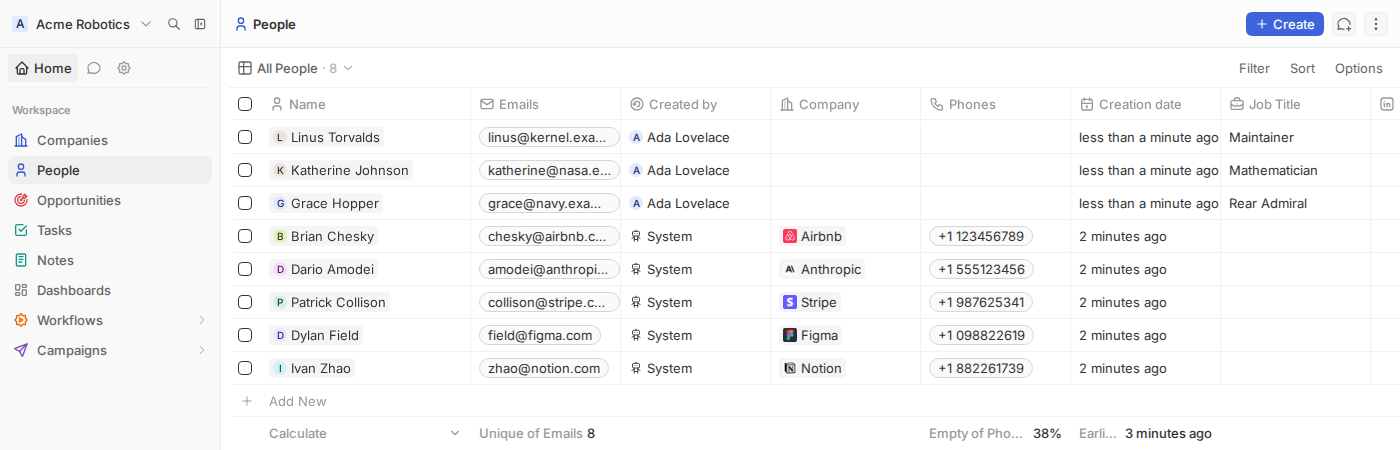
curl -fsSL https://exe-staging.dev/deploy/twenty/prompt.txt | ssh exe.dev new --prompt=/dev/stdinTwenty is an open-source CRM, built as a modern alternative to Salesforce and HubSpot: companies, people and opportunities in fast spreadsheet-like views, a pipeline board, notes and tasks, workflows, custom objects and fields, and a full REST and GraphQL API. It has about 61,000 stars on GitHub and ships a new release every few days.
On exe.dev it runs with Twenty's official Docker images on a VM with a real disk, so your customer data lives on a machine you control. The CRM is private from the start: only people you share the VM with can even reach the sign-in page, and scripts get in with a VM token, so Twenty's APIs never face the internet. Twenty's AI chat works through exe.dev's LLM gateway with no API key, backups run every night, and Shelley, the agent on the VM, can read the logs and change the setup for you.
What you get#
- Twenty 2.60 on PostgreSQL and Redis, back after a reboot.
- A CRM only you and the people you share the VM with can reach, with Twenty's own accounts on top.
- AI chat and agents through exe.dev's LLM gateway, with no API key.
- API access for scripts and other VMs with a VM token and a Twenty API key.
- Nightly backups of the database, uploaded files and encryption key, with a test restore.
What's running, and where
https://my-twenty.exe.xyz/
Twenty, behind exe.dev login and Twenty's own sign-in
https://my-twenty.exe.xyz/rest/
The REST, GraphQL and MCP APIs, for scripts with a VM token and a Twenty API key
Deploy with Shelley#
Click Deploy and Shelley will set up Twenty on a new VM, then check that it works. No config-file wrangling required.
Prefer a terminal?
curl -fsSL \
  https://exe-staging.dev/deploy/twenty/prompt.txt \
  | ssh exe.dev new --prompt=/dev/stdin
What Shelley is told
Set up Twenty on this VM by following the exe.dev recipe at https://exe-staging.dev/deploy/twenty.md?via=deploy from top to bottom.

The recipe's example VM name is my-twenty. This VM's name is the output of `hostname`: use it wherever the recipe writes my-twenty. Skip the step that creates the VM; you are on it.

You are done when all of these are true. Check each one yourself:
- Twenty 2.60 on PostgreSQL and Redis, back after a reboot.
- A CRM only you and the people you share the VM with can reach, with Twenty's own accounts on top.
- AI chat and agents through exe.dev's LLM gateway, with no API key.
- API access for scripts and other VMs with a VM token and a Twenty API key.
- Nightly backups of the database, uploaded files and encryption key, with a test restore.

Read the whole recipe, including the closed details, and follow "Install
by hand" first, skipping VM creation and SSH. The walkthrough before it
is for the owner afterwards. Do not run the public webhook, Restore or
Update instructions during setup.
Work as exedev in ~/twenty. Never overwrite an existing ~/twenty/.env:
it holds the encryption key. Do not create the Twenty workspace or any
account; the first person to sign up becomes the admin, and that must be
the owner. Leave sharing alone.
Verify docker.service is enabled, all four containers run with restart
unless-stopped, localhost:8000/healthz reports "status":"ok", the
gateway answers from the server container, the backup timer is enabled,
and the backup test passes. Do not reboot.
Finish with the URL https://<vm>.exe.xyz/ and tell the owner to open it
right away and create the workspace, since the first sign-up becomes
the admin.

Finish with the URLs I should open.
Also at /deploy/twenty/prompt.txt. The recipe it follows is /deploy/twenty.md.
Create your workspace#
When Shelley finishes, open https://my-twenty.exe.xyz/ and sign in to
exe.dev. Twenty greets you with Welcome to your workspace:
- Choose Continue with Email, enter your email and a password (8 characters or more), and click Sign up.
- Name your workspace, then fill in your name and job title.
- Skip Invite your team for now.
You land on Companies, with five sample companies and people to play with. The first person to sign up owns the workspace and gets the Admin Panel under Settings; after that, nobody can sign up without an invitation. Do this right after install, before you share the VM.
Import your contacts#
Open People, click ⋮ in the top right, and choose Import
People. Upload a .csv, .xlsx or .xls file (up to 10,000 rows),
match its columns to Twenty's fields (First Name to Name / First
Name, Email to Emails / Primary Email, and so on), check the
preview, and click Confirm. Columns you don't match are skipped.
Import companies first, then people with a company column, then opportunities, so each row links to the records it belongs to. Twenty matches companies by name or domain. Every list can go out again as a CSV from the same menu (Export View).
Ask the AI about your CRM#
Click AI in the top left and ask a question in plain language: "Which people did I add this week?", "Create a task to follow up with Grace Hopper on Friday", "Draft a workflow that tags new companies by industry". Twenty reads and writes records through the same permissions you have.
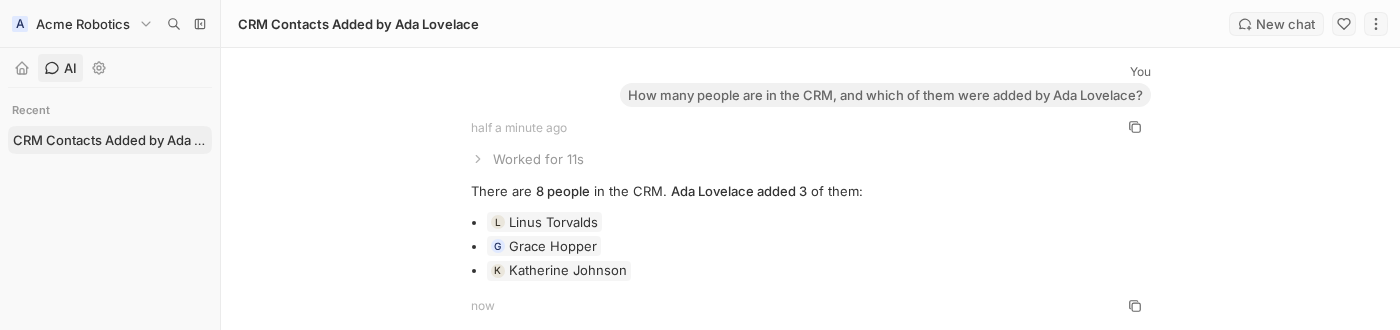
Shelley pointed Twenty's OpenAI provider at exe.dev's LLM gateway, so there's no key to paste. Pick the models for chat and agents under Settings → AI → Models. The same models power the AI steps in workflows. Files you attach to a chat don't reach the model while the VM is private (Twenty sends models a link to them); text works.
Bring your team#
Everyone needs two things: exe.dev access to reach Twenty, and a Twenty account. On your computer, share the VM:
ssh exe.dev share add my-twenty alice@example.com
Then in Twenty, go to Settings → Members, copy the link under
Invite by link, and send it to Alice. She opens it, signs in to
exe.dev, and makes her Twenty account. (Twenty's Invite by email
needs an SMTP server, which this setup doesn't configure.) To remove
someone, remove them in both places: Settings → Members and
ssh exe.dev share remove my-twenty alice@example.com.
Twenty doesn't read exe.dev's login headers, so your team signs in twice: once to exe.dev, once to Twenty. Turn on two-factor authentication under Settings → Profile if you want a second factor for Twenty too.
Use the API from scripts#
In Twenty, go to Settings → Developers, create an API key, pick its role and expiry, and copy it (Twenty shows it once). On your computer, make a VM token so the script can get past exe.dev's login:
ssh exe.dev ssh-key generate-api-key --vm=my-twenty --label=crm-scripts --exp=1y
A script then sends both, one header each:
curl -s https://my-twenty.exe.xyz/rest/people?limit=5 \
  -H "X-Exedev-Authorization: Bearer $EXE_VM_TOKEN" \
  -H "Authorization: Bearer $TWENTY_API_KEY"

curl -s -X POST https://my-twenty.exe.xyz/rest/people \
  -H "X-Exedev-Authorization: Bearer $EXE_VM_TOKEN" \
  -H "Authorization: Bearer $TWENTY_API_KEY" \
  -H 'Content-Type: application/json' \
  -d '{"name":{"firstName":"Ada","lastName":"Lovelace"},"emails":{"primaryEmail":"ada@example.com"}}'
exe.dev checks and strips the first header; Twenty checks the second.
Without the VM token you get exe.dev's 401; without the Twenty key,
Twenty's 403. The same pair works for GraphQL at /graphql, for the
schema at /rest/metadata, and for Twenty's MCP server at /mcp, which
lets Claude Code, Codex or Cursor on another exe.dev VM work with your CRM
(MCP clients that let you set headers can send both). Twenty allows 100
requests a minute per key, and batch calls take up to 60 records.
Going the other way, Settings → Developers → Webhooks makes Twenty
post record changes to a URL you choose, signed with an
X-Twenty-Webhook-Signature header. That URL must be reachable from the
VM, for example a n8n webhook on another VM.
Trigger workflows#
Workflows → Create builds automations: when a record is created or updated, on a schedule, by hand, or from a Webhook trigger. Steps can create, update and find records, send HTTP requests, branch, wait, and run AI prompts. Activate a workflow to make it live.
A webhook trigger shows its Live URL, such as
https://my-twenty.exe.xyz/webhooks/workflows/WORKSPACE_ID/WORKFLOW_ID.
While the VM is private, a sender reaches it with a VM token:
curl -s https://my-twenty.exe.xyz/webhooks/workflows/WORKSPACE_ID/WORKFLOW_ID \
  -H "X-Exedev-Authorization: Bearer $EXE_VM_TOKEN"
# {"workflowName":null,"success":true,"workflowRunId":"18ec99a6-..."}
Services that can't add a header (a payment provider, a form builder) need a public address. exe.dev makes whole ports public, not paths, so Twenty moves to a private port and a small proxy on the public one passes only workflow webhooks: see Public webhooks.
Sync email and calendars#
Twenty can sync Gmail and Google Calendar, or Outlook and Microsoft 365, and attach emails and meetings to the people and companies in them. Each provider needs an OAuth app that you create, because Twenty's own apps only work on Twenty Cloud. We didn't test this end to end (it needs a Google or Microsoft account); the steps follow Twenty's setup guide.
Google. In the Google Cloud console, enable the Gmail, Google Calendar and People APIs, and create an OAuth client ID of type Web application with these redirect URIs:
https://my-twenty.exe.xyz/auth/google/redirect
https://my-twenty.exe.xyz/auth/google-apis/get-access-token
In Twenty, open Settings → Admin Panel → Configuration Variables and
set AUTH_GOOGLE_CLIENT_ID, AUTH_GOOGLE_CLIENT_SECRET, the two
callback URLs (AUTH_GOOGLE_CALLBACK_URL, AUTH_GOOGLE_APIS_CALLBACK_URL),
and turn on MESSAGING_PROVIDER_GMAIL_ENABLED and
CALENDAR_PROVIDER_GOOGLE_ENABLED. While the Google app is in testing
mode, add your address as a test user.
Microsoft. Register an app in Microsoft Entra with the delegated
permissions Mail.ReadWrite, Mail.Send, Calendars.ReadWrite,
User.Read and offline_access (plus openid, email, profile), and
the redirect URIs /auth/microsoft/redirect and
/auth/microsoft-apis/get-access-token on your VM's address. Set the
matching AUTH_MICROSOFT_* variables and turn on
MESSAGING_PROVIDER_MICROSOFT_ENABLED and
CALENDAR_PROVIDER_MICROSOFT_ENABLED. Mailboxes need a Microsoft 365
licence.
Then each person connects their account under Settings → Apps
preferences. The Google or Microsoft sign-in runs in their browser,
which is already signed in to exe.dev, and Twenty then polls for new mail
and events, so nothing has to be public. The tokens are encrypted with
the ENCRYPTION_KEY in ~/twenty/.env.
Any other mailbox. Twenty also connects to mail servers over IMAP, SMTP and CalDAV, with no OAuth app: add an account in the same place and choose the IMAP/SMTP/CalDAV option, with your provider's server names and an app password.
Keep your data#
Backups run nightly into ~/twenty-backups and keep 14. Keep a copy off
the VM too. On your computer:
scp -r my-twenty.exe.xyz:twenty-backups .
Each backup holds the database, uploaded files and .env with the
encryption key, so keep them private. Never replace ~/twenty/.env
with a new one: without its key, connected accounts and stored secrets
can't be decrypted. For whole-disk copies in your own S3 bucket, see
VM backups.
The nuts and bolts#
These are Shelley's setup steps and your maintenance reference. Tested with Twenty 2.60.1, PostgreSQL 16 and Redis 8 on November 21, 2026, including a reboot, an update from 2.59.0, and a restore.
Install by hand
Create a VM#
On your computer (pick another name if my-twenty is taken):
ssh exe.dev new --name=my-twenty
ssh my-twenty.exe.xyz
The remaining commands run on the VM, as exedev.
Write the settings#
Twenty's address, the database password and the encryption key. The file is created only once, so running this again keeps your key:
sudo systemctl enable --now docker.service
mkdir -p ~/twenty/storage ~/twenty/postgres
cd ~/twenty
if [ ! -f .env ]; then
  (umask 077; cat > .env <<EOF
# Twenty's settings and secrets. Back this file up: ENCRYPTION_KEY
# protects connected accounts and other secrets in the database.
TAG=v2.60.1
SERVER_URL=https://$(hostname).exe.xyz
PG_DATABASE_PASSWORD=$(openssl rand -hex 24)
ENCRYPTION_KEY=$(openssl rand -base64 32)
EOF
  )
fi
ls -l .env
ls shows -rw-------. Enabling docker.service brings the containers
back after a reboot. SERVER_URL is the address in your browser; Twenty
puts it in links, webhook URLs and OAuth callbacks.
Write the Compose file#
Twenty's official Compose file
(the server, a worker, PostgreSQL and Redis), with versions pinned, data
in ~/twenty, a longer first-start allowance, and the AI provider:
cd ~/twenty
cat > compose.yaml <<'EOF'
# Twenty CRM: the server (web app and APIs) and worker (sync, imports,
# workflows), PostgreSQL and Redis. Settings and secrets come from .env.
name: twenty

x-twenty-env: &twenty-env
  SERVER_URL: ${SERVER_URL}
  PG_DATABASE_URL: postgres://postgres:${PG_DATABASE_PASSWORD}@db:5432/default
  REDIS_URL: redis://redis:6379
  STORAGE_TYPE: local
  ENCRYPTION_KEY: ${ENCRYPTION_KEY}
  # AI chat and agents through exe.dev's LLM gateway. The gateway needs
  # no key; Twenty wants one, so any text will do.
  AI_PROVIDERS: '{"openai": {"npm": "@ai-sdk/openai", "label": "OpenAI via exe.dev",
    "apiKey": "exe-gateway", "baseUrl": "https://llm.int.exe.xyz/openai/v1",
    "models": [{"name": "gpt-6-luna", "label": "GPT-6 Luna"},
    {"name": "gpt-6.1-sol", "label": "GPT-6.1 Sol"}]}}'

services:
  server:
    image: twentycrm/twenty:${TAG}
    stop_grace_period: 120s
    volumes:
      - ./storage:/app/packages/twenty-server/.local-storage
    ports:
      - "8000:3000"
    environment:
      <<: *twenty-env
      NODE_PORT: 3000
    depends_on:
      db:
        condition: service_healthy
      redis:
        condition: service_healthy
    healthcheck:
      test: curl --fail http://localhost:3000/healthz
      interval: 5s
      timeout: 5s
      retries: 20
      # The first start sets up the database and every start runs
      # migrations, which can take a few minutes.
      start_period: 5m
    restart: unless-stopped

  worker:
    image: twentycrm/twenty:${TAG}
    command: ["yarn", "worker:prod"]
    volumes:
      - ./storage:/app/packages/twenty-server/.local-storage
    environment:
      <<: *twenty-env
      DISABLE_DB_MIGRATIONS: "true"
      DISABLE_CRON_JOBS_REGISTRATION: "true"
    depends_on:
      db:
        condition: service_healthy
      server:
        condition: service_healthy
    restart: unless-stopped

  db:
    image: postgres:16
    volumes:
      - ./postgres:/var/lib/postgresql/data
    environment:
      POSTGRES_DB: default
      POSTGRES_USER: postgres
      POSTGRES_PASSWORD: ${PG_DATABASE_PASSWORD}
    healthcheck:
      test: pg_isready -U postgres -h localhost -d postgres
      interval: 5s
      timeout: 5s
      retries: 10
    restart: unless-stopped

  redis:
    image: redis:8
    command: ["--maxmemory-policy", "noeviction"]
    healthcheck:
      test: ["CMD", "redis-cli", "ping"]
      interval: 5s
      timeout: 5s
      retries: 10
    restart: unless-stopped
EOF
docker compose config --quiet && echo compose ok
Only the server has a port: 8000, the VM's main address, which exe.dev
keeps private until you share it. The model names must be ones the
gateway serves (curl -s https://llm.int.exe.xyz/openai/v1/models);
Twenty fills its Fast, Smart and other modes from those you list.
Start Twenty#
The first pull is about 2.7 GB, and the first start sets up the database, so this takes five minutes or so:
cd ~/twenty
docker compose pull -q
docker compose up -d --wait
curl -s http://localhost:8000/healthz; echo
Expect {"status":"ok",...}. Check that the server can reach the
gateway:
cd ~/twenty
docker compose exec -T server curl -s https://llm.int.exe.xyz/openai/v1/models | head -c 80; echo
The start of a model list means AI chat will work.
Set up nightly backups#
This script saves the database, uploaded files, .env and the Compose
file in one private archive, and keeps the 14 newest:
cat > ~/twenty/backup.sh <<'EOF'
#!/usr/bin/env bash
# Back up Twenty into one tarball: a PostgreSQL dump, the uploaded
# files (storage/), .env with the encryption key, and the configuration.
set -euo pipefail
umask 077
cd "$(dirname "$0")"
dest="$HOME/twenty-backups"
mkdir -p "$dest"
work=$(mktemp -d "$dest/.tmp-XXXXXX")
trap 'rm -rf "$work"' EXIT

docker compose exec -T db pg_dump -U postgres -d default --format=custom > "$work/twenty.dump"
cp -a .env compose.yaml backup.sh storage "$work/"
if [ -f nginx.conf ]; then cp -a nginx.conf "$work/"; fi

out="$dest/twenty-$(date -u +%Y%m%d-%H%M%S).tar.gz"
tar -czf "$out.part" -C "$work" .
mv "$out.part" "$out"

# Keep the 14 newest backups.
ls -1t "$dest"/twenty-*.tar.gz | tail -n +15 | xargs -r rm --
echo "$out"
EOF
chmod +x ~/twenty/backup.sh
Schedule it, then take a first backup:
sudo tee /etc/systemd/system/twenty-backup.service >/dev/null <<EOF
[Unit]
Description=Back up Twenty (database, files, .env) to ~/twenty-backups
Requires=docker.service
After=docker.service

[Service]
Type=oneshot
User=$USER
ExecStart=$HOME/twenty/backup.sh
EOF
sudo tee /etc/systemd/system/twenty-backup.timer >/dev/null <<'EOF'
[Unit]
Description=Back up Twenty every night

[Timer]
OnCalendar=*-*-* 03:30:00
RandomizedDelaySec=30m
Persistent=true

[Install]
WantedBy=timers.target
EOF
sudo systemctl daemon-reload
sudo systemctl enable --now twenty-backup.timer
sudo systemctl start twenty-backup.service
systemctl list-timers twenty-backup.timer --no-pager
ls -lh ~/twenty-backups
The timer shows a next run and the directory holds a tarball. For
failures: journalctl -u twenty-backup.service.
Test a backup#
Restore the newest backup into a scratch database, not the running one:
latest=$(ls -1t ~/twenty-backups/twenty-*.tar.gz | head -n 1)
mkdir -p /tmp/twenty-restore-test/postgres
tar -xzf "$latest" -C /tmp/twenty-restore-test
cd /tmp/twenty-restore-test
docker compose -p twenty-restore-test up -d --wait db
docker compose -p twenty-restore-test exec -T db pg_restore -U postgres -d default --no-owner --exit-on-error < twenty.dump
docker compose -p twenty-restore-test exec -T db psql -U postgres -d default -tAc \
  "select 'core tables: ' || count(*) from pg_tables where schemaname = 'core'"
Expect several dozen core tables (once the workspace exists, its data is
in a workspace_... schema next to them). Remove only this scratch copy
afterwards:
cd /tmp/twenty-restore-test && docker compose -p twenty-restore-test down
cd ~ && sudo rm -rf /tmp/twenty-restore-test
Installation done. Leave the workspace and sharing to the owner; continue with Create your workspace.
Public webhooks
exe.dev can make one port public: 8000, the VM's main address. To take
workflow webhooks from services that can't send a VM token, Twenty moves
to the private port 3000 and nginx on port 8000 passes only
/webhooks/workflows/... and the health check. Everything else,
including the sign-in page, /rest and /graphql, redirects to port
3000, behind exe.dev login.
On the VM:
cd ~/twenty
cat > nginx.conf <<'EOF'
# Port 8000 is the port exe.dev can make public. Pass only Twenty's
# workflow webhook triggers and its health check; send everything else,
# the app and its APIs included, to the private port 3000.
server {
    listen 80 default_server;
    server_tokens off;

    resolver 127.0.0.11 valid=10s ipv6=off;
    set $twenty http://server:3000;

    client_max_body_size 10m;
    proxy_http_version 1.1;
    proxy_set_header Host $host;
    proxy_set_header X-Forwarded-For $http_x_forwarded_for;
    proxy_set_header X-Forwarded-Proto $http_x_forwarded_proto;

    location ~ ^/(webhooks/workflows/|healthz$) {
        # Check the raw path too, so encoded tricks can't reach anything else.
        if ($request_uri !~ ^/(webhooks/workflows/[0-9a-f-]+/[0-9a-f-]+/?(\?|$)|healthz$)) {
            return 404;
        }
        proxy_pass $twenty;
    }

    location / {
        return 302 https://$host:3000$request_uri;
    }
}
EOF
sed -i "s|^SERVER_URL=.*|SERVER_URL=https://$(hostname).exe.xyz:3000|" .env
sed -i 's|"8000:3000"|"3000:3000"|' compose.yaml
cat >> compose.yaml <<'EOF'

  public:
    image: nginx:1.30-alpine
    ports:
      - "8000:80"
    volumes:
      - ./nginx.conf:/etc/nginx/conf.d/default.conf:ro
    depends_on:
      - server
    restart: unless-stopped
EOF
docker compose up -d --wait
for p in /healthz /rest/people /graphql /welcome; do
  printf '%s %s\n' "$(curl -s -o /dev/null -w '%{http_code}' localhost:8000$p)" $p
done
/healthz answers 200, the rest 302. Twenty is now at
https://my-twenty.exe.xyz:3000/; sign in there. Then, on your computer:
ssh exe.dev share set-public my-twenty
Webhook URLs in Twenty now show port 3000: give senders the same URL
without :3000. Anyone with a webhook URL can start that workflow, so
treat it as a secret and have the workflow check what it receives. If you
set up Google or Microsoft sync before this, add :3000 to the redirect
URIs and callback URLs. To close the public port again:
ssh exe.dev share set-private my-twenty.
Back up and restore
On the VM, ~/twenty/backup.sh makes an extra backup and prints its
path. Each archive has the database, uploaded files and encryption key;
restore them together.
Restore#
Make a new VM as in Create a VM (or use the old one), then copy your backup over. On your computer:
scp twenty-20261121-033012.tar.gz my-twenty.exe.xyz:
Use your backup's actual filename here and below. The rest runs on the VM. If Twenty already runs there, stop it and keep its directory aside first:
cd ~/twenty && docker compose down
sudo mv ~/twenty ~/twenty.before-restore
Unpack the backup, set this VM's address, and load the database before starting Twenty:
sudo systemctl enable --now docker.service
mkdir -p ~/twenty/postgres
tar -xzf ~/twenty-20261121-033012.tar.gz -C ~/twenty
cd ~/twenty
sed -i "s/[a-z0-9-]*\.exe\.xyz/$(hostname).exe.xyz/" .env
docker compose up -d --wait db redis
docker compose exec -T db pg_restore -U postgres -d default --no-owner --exit-on-error < twenty.dump
docker compose up -d --wait
curl -s http://localhost:8000/healthz; echo
Sign in and check your records. On a new VM, also recreate the backup
timer and share the VM with your team again. Keep
~/twenty.before-restore until you're happy.
Update Twenty
Twenty releases every few days; pick a version from its
releases and read the
upgrade guide.
You can jump several versions at once: the server runs every migration
in between when it starts. On the VM, back up, set only TAG in
.env (put your version in place of v2.60.1), then pull and restart:
cd ~/twenty
./backup.sh
sed -i 's/^TAG=.*/TAG=v2.60.1/' .env
docker compose pull -q
docker compose up -d --wait
docker compose exec -T server yarn command:prod upgrade:status
upgrade:status lists the instance and each workspace as up to date. To
roll back, restore the backup: an older image won't undo
database migrations.
Something not working?
On the VM:
cd ~/twenty
docker compose ps
docker compose logs --tail=100 server worker
up --waitfails on the first start, or the worker stays "Created": the server was still setting up the database. Rundocker compose up -d --waitagain; it carries on where it stopped.- The page keeps redirecting, or links point to the wrong address:
SERVER_URLin.envmust match the address in your browser, including:3000if you set up public webhooks. Change it, thendocker compose up -d --wait. - A script gets
401with an HTML or text body: that's exe.dev; send theX-Exedev-Authorizationheader with a VM token that hasn't expired. A JSON401or403comes from Twenty: check the API key. - AI chat says no model is available: check the gateway from the
server (
docker compose exec -T server curl -s https://llm.int.exe.xyz/openai/v1/models) and that the models inAI_PROVIDERSare in its list. - Connected Gmail or Outlook accounts stopped syncing after a restore:
the
.envdidn't come with the database. Restore both from the same backup, or reconnect the accounts. - Out of disk:
df -h /. Old images from updates go withdocker image prune. To grow the disk, on your computer runssh exe.dev resize my-twenty --disk=50GB, then on the VMsudo resize2fs "$(findmnt -no SOURCE /)".
Frequently asked questions#
Is self-hosted Twenty free?
Yes. Twenty is AGPL-3.0, with no limit on users or records. A few enterprise features (SSO, row-level permissions, record sharing, custom roles, audit logs) need a paid enterprise key. You pay for the VM: in our test the stack used about 2 GB of memory and 3 GB of disk for its images.
Can I keep Twenty private and still use its API?
Yes. Scripts and other servers send a VM token for exe.dev and a Twenty API key for Twenty, both as headers. Twenty's own security guide says to keep /rest and /graphql off the public internet, which is exactly what exe.dev does by default.
Does Twenty's AI work without an OpenAI key?
Yes. This setup points Twenty's OpenAI provider at exe.dev's LLM gateway, so AI chat, AI workflow steps and agents work with no key on the VM. Usage counts against your exe.dev LLM allocation.
Can Twenty sync Gmail, Google Calendar or Outlook?
Yes, once you create your own OAuth app with Google or Microsoft and give Twenty its client ID and secret; other mailboxes connect over IMAP, SMTP and CalDAV. The sign-in happens in your browser and Twenty polls for new mail, so this works while the VM is private. See Sync email and calendars.
Can Zapier, Make or a payment provider call Twenty?
Not while the VM is private: hosted services can't sign in to exe.dev. Run your automations on exe.dev instead (n8n on another VM with a VM token), or open only Twenty's workflow webhooks to the internet with the public front door.
How do I move from Twenty Cloud or another CRM?
Export CSV files (companies first, then people, then opportunities) and import them in the same order, so people link to their companies. Each import takes up to 10,000 rows; for more, split the file or use the API.
How much data can it hold?
As much as the VM's disk. A small CRM is a few hundred MB including attachments; you can grow the disk later, or keep files in S3 with STORAGE_TYPE=S_3 (see S3 storage).
Published Nov 21, 2026 · Updated Nov 21, 2026 · tested end to end Nov 21, 2026 · Markdown · manifest.json · Something wrong? Tell us